Powerful Legal Notice for Recovery of Money in India
A legal notice for recovery of money is a formal written demand sent to a person or business that owes you money. It tells them exactly how much they owe, why they owe it, and a clear deadline to pay. It also warns that you may take legal action (civil suit, cheque bounce case, MSME reference, arbitration, or other remedies) if they do not respond.
In most private money disputes, sending a money recovery notice is not strictly mandatory, but it is usually the smartest first step. Here’s why: it creates a written record, it often triggers payment or settlement talks, and it helps your lawyer frame the case later if you have to file in court.
A good legal notice for money recovery is short, factual, and backed by documents.
If you want more plain-English legal guides like this, explore the LawGhar legal information hub. It should avoid emotional accusations and avoid threatening criminal action unless the facts truly support it. If the opposite side pays after receiving the notice, you save time, court fees, and stress.
What you should do next: gather proof (messages, invoices, loan proof, bank statements, return memo for cheque, etc.), decide the correct legal route, and then send a properly drafted notice.
Disclaimer: LawGhar is a legal blog for informational and educational purposes only. The information provided herein does not constitute legal advice and should not be relied upon as such. Viewing this content does not create an attorney-client relationship between you and LawGhar, its owners, or contributors. Always consult with a qualified legal professional for advice concerning your individual legal needs.
Why a legal notice works (and what makes it legally meaningful)

Think of a legal notice as a last clear opportunity you give the debtor to fix the problem.
A well-drafted notice helps because it:
- Sets out the cause of action clearly (what happened, when, and how much is due).
- Marks your demand date and supports a claim for interest and costs.
- Shows your readiness to enforce rights through the correct forum.
- Creates a clean paper trail if the matter reaches court.
Laws that commonly support money recovery claims
Your exact remedy depends on your facts, but these are the most common legal foundations in India:
- Contract and promises: If money is due under a contract (written or proved through emails/WhatsApp), you can seek compensation for breach and sometimes interest.
- Civil recovery through court: You can file a suit for the recovery of money. In some cases, a faster summary suit may be possible.
- Cheque bounce: If a cheque was issued and bounced, a notice is part of the statutory process.
- Business dues for MSMEs: Micro and small enterprises often have a special route through the Facilitation Council with strong interest provisions.
- Criminal provisions (only where facts fit): If there was deception from the start (cheating) or entrustment followed by dishonest misappropriation (criminal breach of trust), criminal law may apply. But criminal law should not be used as a pressure tool for a pure civil dispute.
Key legal provisions and timelines (quick reference)
- Cheque bounce (Negotiable Instruments Act, 1881, Section 138): If a cheque is returned unpaid, the payee must usually issue a written demand notice within 30 days of receiving information of dishonour from the bank. The drawer then gets 15 days from receipt of the notice to pay, failing which a complaint can be filed as per the Act.
- Summary suit for clear debts (Code of Civil Procedure, 1908, Order XXXVII): Applies to specific courts and to suits on bills of exchange, hundies, promissory notes, and many cases where only a debt or liquidated sum is claimed based on a written contract, enactment, or guarantee. The defendant typically must enter an appearance within 10 days of service, or the allegations may be treated as admitted.
- Notice before suing Government (CPC Section 80): Generally requires a 2-month prior notice before filing a suit against the Government or a public officer for acts in an official capacity. For urgent relief, a suit may be filed with court leave without serving notice, but relief is not granted without giving the Government a reasonable chance to respond.
- Commercial disputes (Commercial Courts Act, 2015, Section 12A): For many commercial suits without urgent interim relief, pre-institution mediation must be exhausted. Mediation is to be completed within 3 months, extendable by 2 months with consent. The mediation period is not counted for the limitation.
- Limitation (Limitation Act, 1963): Many money recovery suits are 3-year claims, but the exact limitation depends on the transaction type (for example, a claim for money lent and the residuary category has different schedule entries). Act early if your claim is close to becoming time-barred.
- MSME dues (MSMED Act, 2006, Sections 15–18): Written payment terms cannot exceed 45 days from acceptance/deemed acceptance. If the buyer defaults, interest can be compounded with monthly rests at three times the RBI bank rate. Disputes can be referred to the MSME Facilitation Council. For filing and tracking delayed payment cases, you can also check the official MSME Samadhaan portal.
- Contract damages (Indian Contract Act, 1872): Section 73 covers compensation for loss caused by breach. Section 74 deals with compensation where a contract names a sum payable on breach (liquidated damages/penalty clauses).
- Criminal law (Bharatiya Nyaya Sanhita, 2023): Cheating (Section 318) requires deception and dishonest inducement. Criminal breach of trust (Section 316) requires entrustment and dishonest misappropriation. Extortion (Section 308) involves inducing the delivery of property by putting a person in fear of injury. Criminal provisions should be invoked only when the facts genuinely match these ingredients.
Before you send the notice: a quick evidence checklist
A legal notice becomes much stronger when the facts are easy to prove.
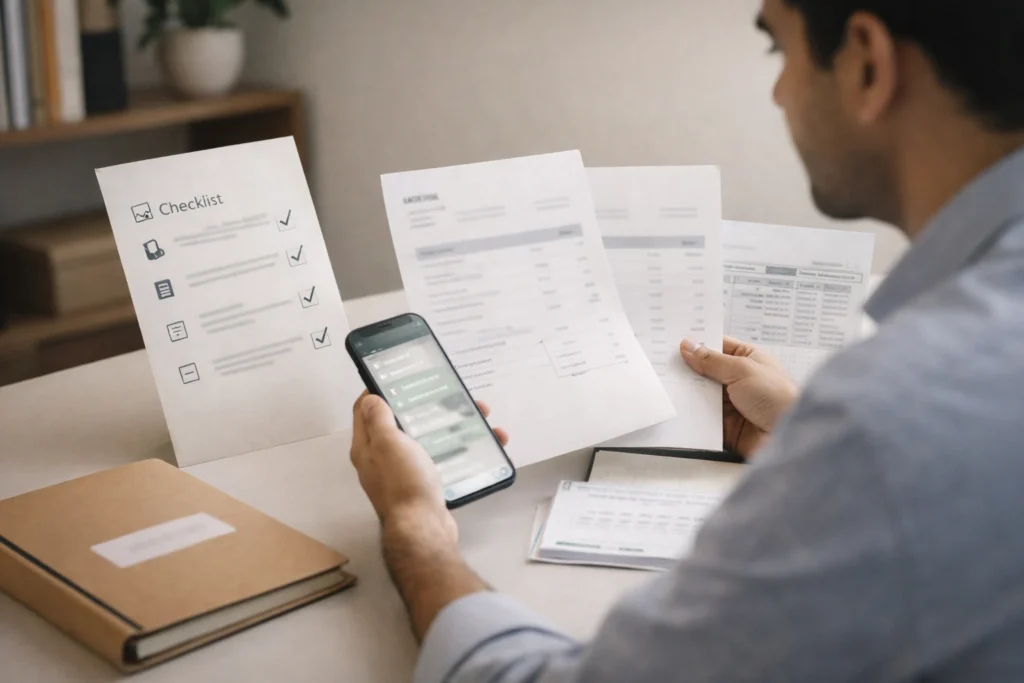
Collect what applies to your case:
- Written agreement, work order, purchase order, invoice, delivery proof
- WhatsApp chats, emails, call recordings (if legally recorded), and acknowledgement messages
- Bank statements showing the transfer of money
- Promissory note, IOU, post-dated cheques, security cheques
- Cheque return memo from the bank (if the cheque bounced)
- Ledger account and payment follow-up emails
- Any admission of liability (even a short message like “I will pay next week”)
Tip: An acknowledgement of debt in writing can matter a lot for limitation and negotiations.
Legal notice format for recovery of money (copy-paste)
Below is a practical legal notice format for the recovery of money. Use it as a draft and tailor it to your facts. Do not add allegations you cannot prove.
LEGAL NOTICE
Date: [DD/MM/YYYY]
To,
[Name of Debtor/Company]
[Address]
[Email, if known]
Subject: Legal notice for recovery of money of ₹[Amount] (Outstanding dues)
- I, [Your Name], residing at [Your Address], through this notice, call upon you to pay the outstanding amount of ₹[Amount] due to me/us.
- Background and transaction:
- On [Date], you [borrowed/received goods/availed services] from me/us.
- The agreed terms were: [brief terms, payment date, interest if agreed].
- Proof documents include: [Agreement/Invoice No./Bank transfer details/WhatsApp confirmation].
- Amount due (break-up):
- Principal due: ₹[ ]
- Interest (if applicable): ₹[ ] at [rate]% p.a. from [date]
- Any contractual charges (if applicable): ₹[ ]
- Total demanded as on today: ₹[Total]
- Previous requests: Despite repeated reminders on [dates], you have failed to clear the dues. Your failure has caused financial loss and hardship.
- Demand: You are hereby called upon to pay ₹[Total] within [15/7/30] days of receipt of this notice, by NEFT/UPI to:
- Account Name: [ ]
- Bank/Branch: [ ]
- Account No.: [ ]
- IFSC: [ ]
- UPI ID (optional): [ ]
- Legal action warning: If you fail to comply within the above time, I/we will be constrained to initiate appropriate legal proceedings, including civil recovery proceedings and any other remedy available in law, at your cost and risk, without further reference.
- Settlement window (optional but useful): If you wish to resolve this amicably, you may respond in writing within [7] days with a payment plan proposal.
Sincerely,
[Your Name]
[Phone]
[Email]Through Counsel (if sending via advocate):
[Advocate Name]
[Enrolment No.]
[Address]
Recovery Money Legal Notice Format: what to customize
- Use dates and numbers. Avoid vague language.
- Add a clear break-up of the money claimed.
- Mention the jurisdiction only if you are sure.
- If there is an arbitration clause, your notice may need a different structure.
Which legal route fits your situation
Most people lose time because they pick the wrong route. Here’s a practical map.
Two-sentence summary: The best route depends on your documents and the relationship with the debtor. If you have written proof of a fixed debt, you may be able to use a faster process.
|
Situation |
Common first step |
Strong next legal option |
|---|---|---|
|
Friendly loan not repaid |
Money recovery notice |
Civil recovery suit (and sometimes summary suit if documents fit) |
|
Invoice/service dues |
Legal notice for money recovery |
Civil suit; Commercial Court route (if it is a commercial dispute) |
|
Cheque bounced |
Statutory notice |
Cheque bounce case (NI Act) + civil suit (if needed) |
|
MSME supplier unpaid |
Demand notice + documentation |
MSME Facilitation Council reference (with strong interest) |
|
The contract has an arbitration clause |
Notice invoking dispute |
Arbitration route (and court support if needed) |
|
Clear fraud from the beginning |
Carefully drafted notice |
Criminal complaint (only when facts truly support it) |
Deadlines and mandatory notice situations people miss
This is where many people make mistakes.
1) Cheque bounce cases have strict notice timing
If your money recovery notice is based on a bounced cheque, the law has its own timeline. In simple terms, after you receive the bank’s return memo for cheque dishonour, you must send the statutory demand notice within the prescribed time, and the drawer gets a short window to pay.
2) Suing the Government usually requires a Section 80 notice
If the debtor is the Government or a public officer (for an act in official capacity), a Section 80 CPC notice is generally required, and you usually have to wait before filing, unless the court allows you to sue for urgent relief without notice.
3) Many commercial money disputes now require pre-institution mediation
If your claim qualifies as a commercial dispute and you are not seeking urgent interim relief, the law can require you to attempt pre-institution mediation before filing a suit.
4) A summary suit can speed up clear debt cases
If your claim is for a debt or liquidated demand based on written documents (or negotiable instruments), you may qualify for a summary suit where the defendant cannot defend the case unless the court grants leave.
5) The limitation period can quietly kill a strong case
Money recovery cases often fail because the claim becomes time-barred. Many money claims are governed by a 3-year limitation from the date the right to sue arises, but the exact period depends on the nature of the transaction.
Common scenarios and what changes in each one
Different money disputes need slightly different wording and proof. Use the closest scenario below so your notice stays accurate and effective.
This is the part most generic articles skip.
Legal notice for recovery of money from a friend or relative
- Keep the tone respectful. Friendly loans turn ugly fast.
- Mention the transfer proof and any written acknowledgement.
- Avoid criminal threats unless there is real deception.
Money recovery notice to a company or business
- Address it to the registered office and mark it to the authorized signatory.
- Attach a simple statement of account and an invoice list.
- If it is a commercial dispute, your next step may involve pre-institution mediation.
Legal notice for money recovery in rent and security deposit disputes
- Be precise about rent due, adjustment terms, and handover date.
- If the issue is mainly about possession and tenancy, legal strategy can change. Get specific advice.
Recovery of money linked to divorce settlements or maintenance
Sometimes the “money recovery” issue is tied to family court proceedings. Examples include an unpaid settlement amount recorded in mutual consent terms or financial directions passed during a matrimonial case.
In these situations, the next step may not look like a standard civil recovery suit. The procedure often depends on what the court has already recorded and what enforcement method is available.
If your dispute is connected to a matrimonial case, these LawGhar reads can help you understand the process and expectations before you act:
For a broader context on how family disputes are showing up more visibly in courts, you can also read: Divorce rate in India 2026: causes, laws, trends.
When an arbitration clause is present
- A normal demand notice may not be enough.
- You may need to send a notice that triggers arbitration timelines and preserves rights.
When criminal sections are mentioned in money recovery disputes
This is sensitive. Here’s the safe rule:
- Cheating usually requires dishonesty from the beginning.
- Criminal breach of trust usually requires entrustment and later dishonest misuse.
- Pure non-payment of money, without these elements, is typically a civil dispute.
Also note: many older articles quote IPC sections like 406 and 420. Those references have changed after the newer criminal law came into force. Your lawyer will apply the correct current provisions.
What experienced lawyers do differently
Most money recovery notices fail for one simple reason: they read like an angry message, not like a case file.
If you want your legal notice for recovery of money to work, treat it like a mini-brief:
- Make the claim easy to verify. A debtor will argue less when you provide a clean break-up and attach proof.
- Pick one strong legal route, not five weak threats. Randomly adding criminal allegations can backfire and reduce credibility.
- Leave a settlement door open, but define it. A clear payment plan window often recovers money faster than a fight.
- Protect the limitation from Day 1. If your claim is nearing the limitation period, you may need an urgent filing strategy.
- Avoid overclaiming interest. Claim what you can justify by contract, invoices, trade practice, or law.
A good notice is calm, specific, and firm. It feels like it was written by someone who will actually file the case.
How to send a legal notice in India (simple steps)
This is the practical, low-risk way to send a notice so you can prove delivery later and avoid service disputes.
- Choose delivery methods: speed post/registered post with tracking is common. Email/WhatsApp can support proof, but physical service is often safer.
- Keep proof of dispatch: postal receipt, tracking, email delivery logs, and a copy of the notice.
- Send to the correct address: for companies, use the registered office address.
- Do not send originals: send copies; keep originals safe.
FAQs
What is a legal notice for the recovery of money?
A legal notice for recovery of money is a formal demand letter that states the amount due, the reason for the debt, and a deadline to pay before legal action.
Is a legal notice mandatory before filing a money recovery case in India?
Usually, no for private disputes. But it can be mandatory in specific situations like cheque bounce matters, Government-related suits, and many commercial disputes.
What is the ideal time limit to give in a money recovery notice?
Most people give 7 to 15 days. For some laws, like cheque bounce, the timeline is fixed by statute. If your claim is urgent, consult a lawyer before delaying.
How much does it cost to send a legal notice in India?
It depends on complexity, documents, and the lawyer’s experience. Simple notices cost less; business disputes with multiple invoices cost more.
Can I send a legal notice myself without a lawyer?
Yes, you can. But a lawyer-drafted notice is often more effective because it uses the right legal language, avoids risky allegations, and sets up the next step correctly.
What if the person ignores my legal notice for money recovery?
If they ignore it, you usually move to the next legal step, such as a civil suit, summary suit, cheque bounce case, MSME reference, or arbitration, depending on your documents.
Can I claim interest in a legal notice for the recovery of money?
Yes, you can claim interest if it is agreed in writing, appears in invoices/terms, or is supported by law. Keep the rate reasonable and explain the basis.
Can I file a criminal case to recover money?
Only if the facts show a criminal offence like cheating from the start or dishonest misuse of entrusted property. A pure payment dispute is usually civil.
Download the LawGhar legal notice template (ready to use)
If you want a cleaner, lawyer-style draft without guessing what to write, download our editable template.
Download Legal Notice for Recovery of Money (Word .DOCX):
What you get in the download
- A fill-in template for a legal notice for the recovery of money (individual or business)
- A simple amount break-up section (principal, interest, charges)
- An annexure list so you can attach invoices, bank proof, chats, cheque memo, etc.
- Add-on pages for common scenarios (cheque bounce, MSME dues, Section 80 CPC, arbitration clause)
How to use it (fast)
- Fill in names, dates, amount, and payment deadline.
- Attach the proof you already have (keep originals safe).
- Send it to the correct address (registered office for companies) and keep delivery proof.
If the other side still does not pay or reply, speak to a qualified lawyer to choose the correct next step (civil suit, summary suit, NI Act route, MSME reference, or arbitration).